


| City/Town: • Talihina |
| Location Class: • Hospital |
| Built: • 1937 | Abandoned: • 1999 |
| Historic Designation: • Native American Heritage Site |
| Status: • Abandoned |
| Photojournalist: |
Choctaw-Chickasaw Hospital/Talihina Indian Hospital
It was all the talk on the Choctaw Nation Reservation about the growth of the Nation’s healthcare system happening right before their eyes. Having outgrown the first hospital, which was a wood-frame building referred to as the Carter Hospital, a brand new tribal health complex, shared between the Choctaw and Chickasaw Nations, was coming to life.
Chicago architects Schmidt, Garden, and Erickson were brought onto the project to design the new complex in 1937. The whole complex was to cost around $950,000 and would use materials largely gathered from nearby Buffalo Mountain. Construction work was carried out by Manhatten Construction Co. of Muskogee, Choctaw citizens, and workers brought in by the Works Progress Administration.
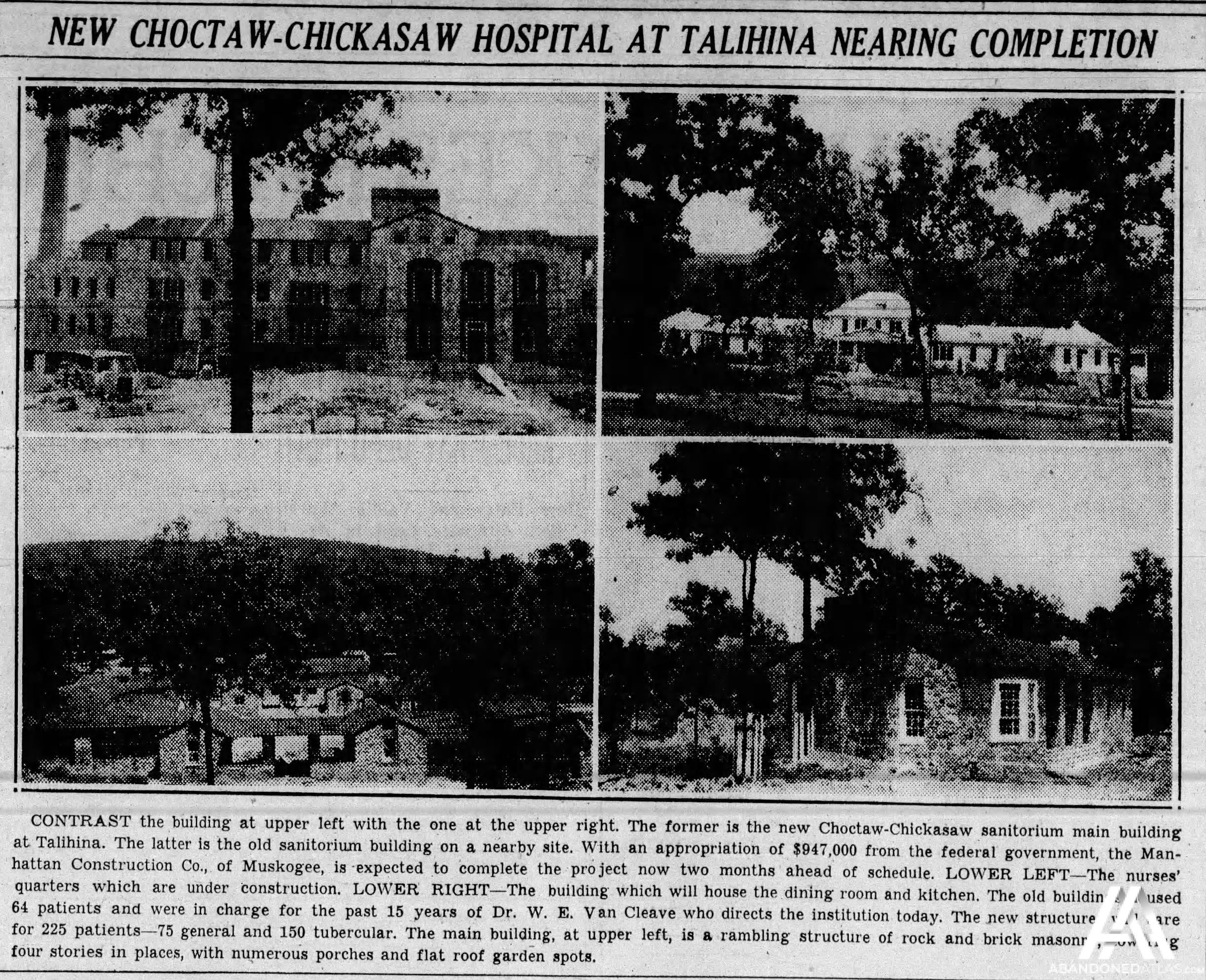
The Choctaw-Chickasaw Hospital was built just one mile west of the Eastern Oklahoma State Sanitorium. The tranquil setting of Tahilina, which is known for its picturesque beauty between nature and civilization, became a hub for medical care. Workers building the hospital often noted how much wildlife they would see during construction days; one worker even noted seeing around 32 turkeys in the area in one morning.
The new Choctaw-Chickasaw Hospital opened in June 1938. This was a month earlier than originally anticipated due to the efficiency of all those working on the construction front. A formal dedication ceremony was held a few months later on October 4, 1938. A large group of prominent Tribal officials was present. Choctaw Chief William A. Durant and Superintendent of the Muskogee Indian Agency A.M. Landman accepted the agency on behalf of the Five Civilized Tribes. Principal Chief of the Muscogee Creek Nation Roley Canard, Former Choctaw Chief Ben Dwight, Chickasaw Governor William Johnston were also present.
Many non-tribal citizens from surrounding communities attended. Of the dedication, A.C. Monohan served as the chairman, an invocation was given by Rev. Grady James and addresses were given by Senator Elmer Thomas, Congressman Wilburn Cartwright, and State Health Commissioner C.M. Pearce.
Those who attended the ceremony possibly looked back with an unfond memory. The luncheon was held at the event and gave nearly everyone food poisoning. Doctors, nurses, townspeople, and dignitaries fell ill and filled the hospitals.
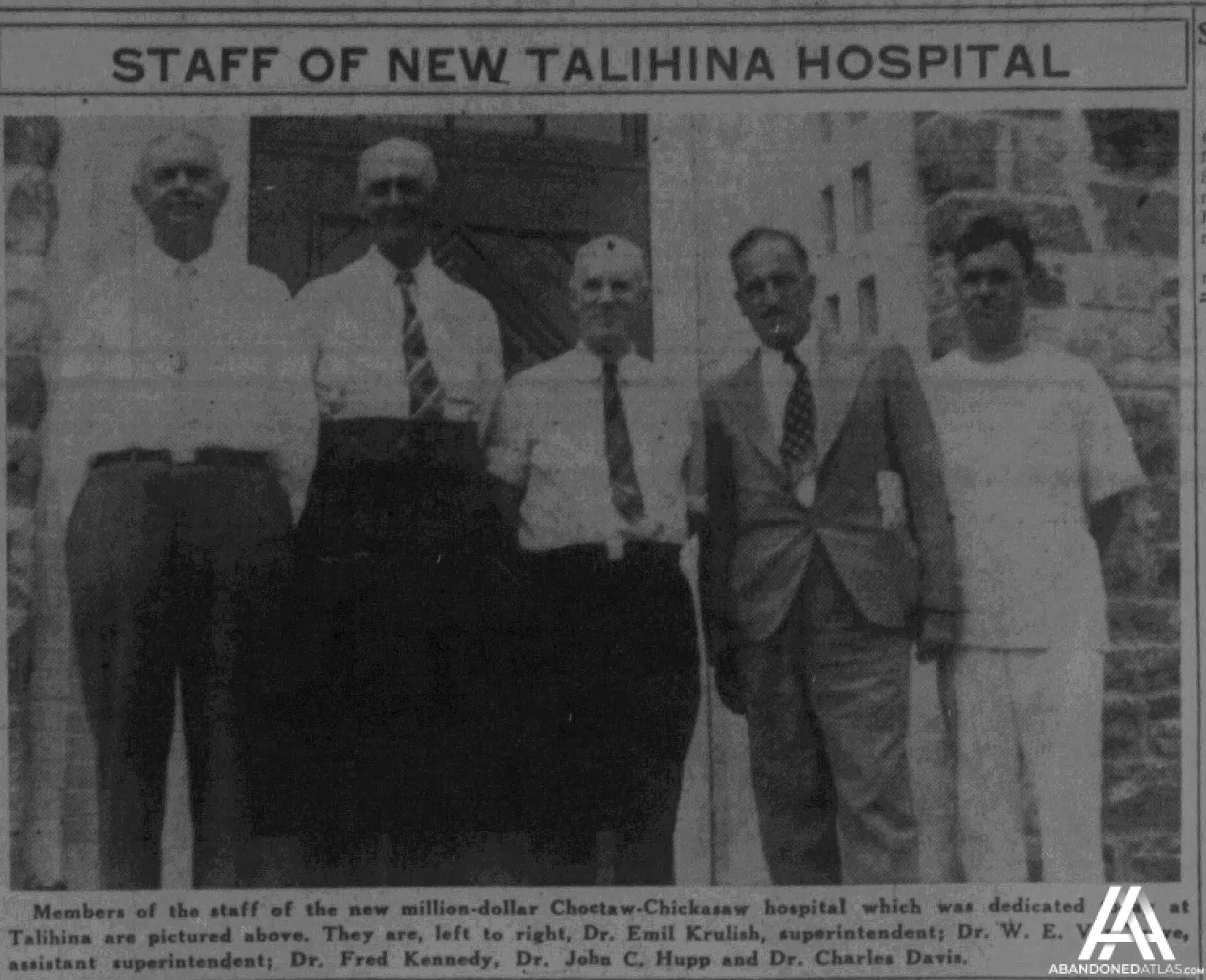
Staffing the massive facility began with only five physicians. Those were Dr. Emil Krulish, who also served as Superintendent, Dr. W.E. VanCleave Assistant Superintendent, Dr. Fred Kennedy, Dr. John C. Hupp, and Dr. Charles Davis. This would be expanded rather quickly to include three more physicians, bringing the total to eight.
Improvements were made in the following two years, with asphalt being laid on the driveways. Junie Smith headed the project and oversaw the thirty-five workers who were completing the work. Of the workers, twenty were Native.
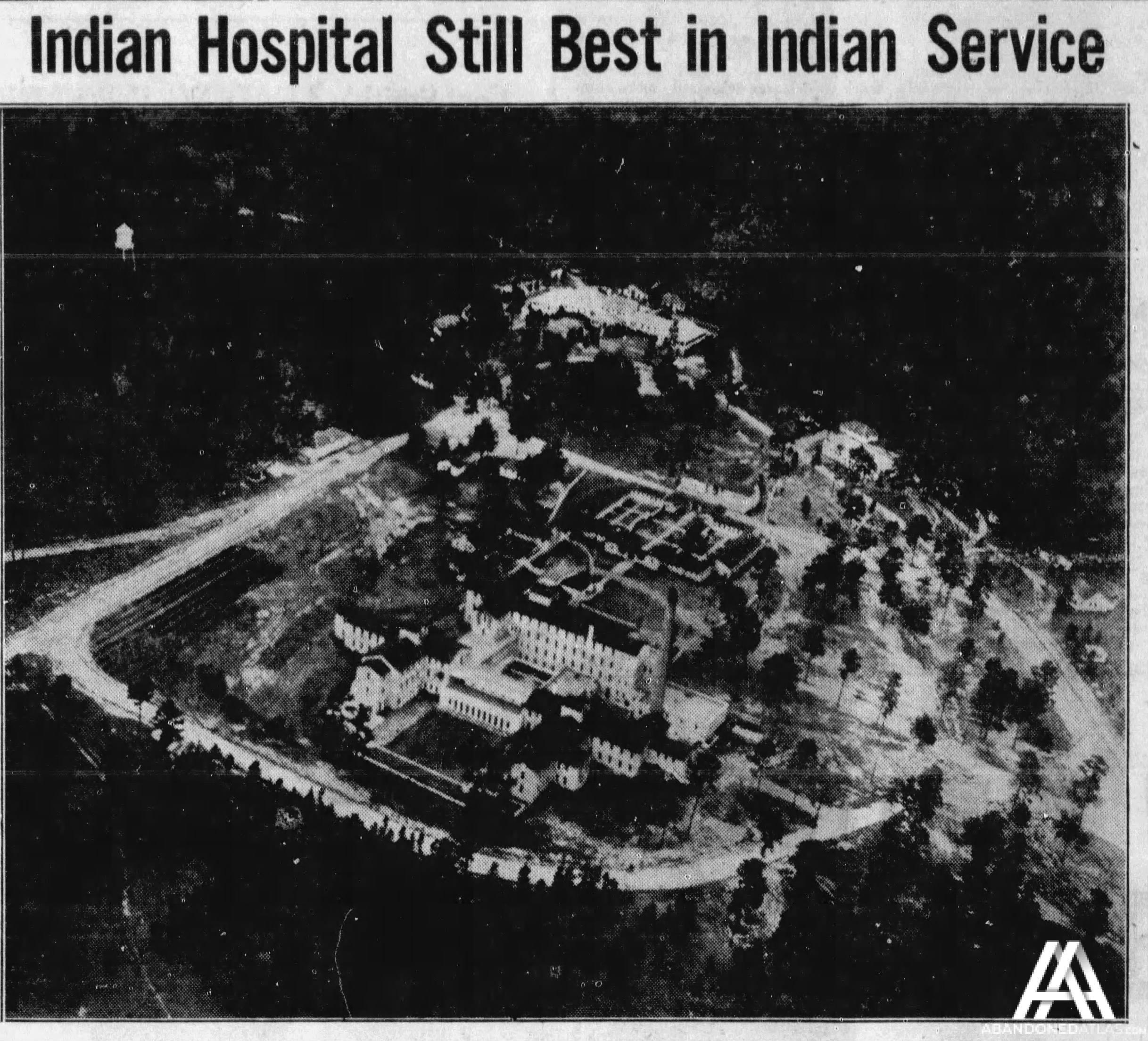
The 1940s brought growth and success to the hospital. They were already reaching an average of around 230 patients monthly. In March 1940, they hit a high of 255 patients and 22 babies born. It was around this time that it more commonly became referred to as the ‘Talihina Indian Hospital’.
Dr. David H. Gillick served as the Superintendent during this monumental time. Under his direction, the hospital received the highest honor that a hospital could receive, with full approval by the American College of Surgeons. At the same time, they received the high honor, the training hospital was desperately struggling with staffing issues. One of the worst in the state, at one point, Dr. Gillick was providing all of the surgical operations for the 140 patients under his care.
The hospital continued receiving national recognition, being only one of eleven hospitals in the nation in 1949 to be considered exemplary. It was the only Indian hospital in the country to be selected. This status meant that most people wanted to seek care here, wanting the best of the best. But only tribal members of the Five Civilized Tribes could be tended to in the Indian Hospital. This prompted Dr. Gillick to put out the rules in the 1948 newspapers, explaining the law and that only under emergency circumstances, with no other hospital reachable, would non-tribal members be seen.
Talihina Medical Center
Ryan Spring, a historian and historic preservationist of the Choctaw Nation, writes about the hospital during what in Native history is referred to as the ‘termination era’. “During the mid-twentieth century, national policy promulgated by Congress shifted to a period known as termination following a series of laws aimed at dismantling tribal sovereignty (Godfrey 2017, also see Lowitt 2007). Posited as an honor conferred on the institution due to its efficiency and growth, in 1950, the Indian Service officially changed the name of the Talihina Indian Hospital to the Talihina Medical Center. At the time, it was the only Indian medical center in Oklahoma and only one of three in the United States (Navajo, Arizona and Edgecombe, Alaska).
Following the designation, the hospital had anticipated that its $530,000 annual budget would increase, given that it was now one of the largest Native hospitals in the United States. But the opposite happened and the hospital faced cuts. The backlash ensued and hospital and state officials argued to the higher-ups of Washington D.C. that these cuts would be extremely harmful to an already understaffed facility. The cuts were revised, but only minorly, to cut 16 jobs instead of the planned 23 jobs.
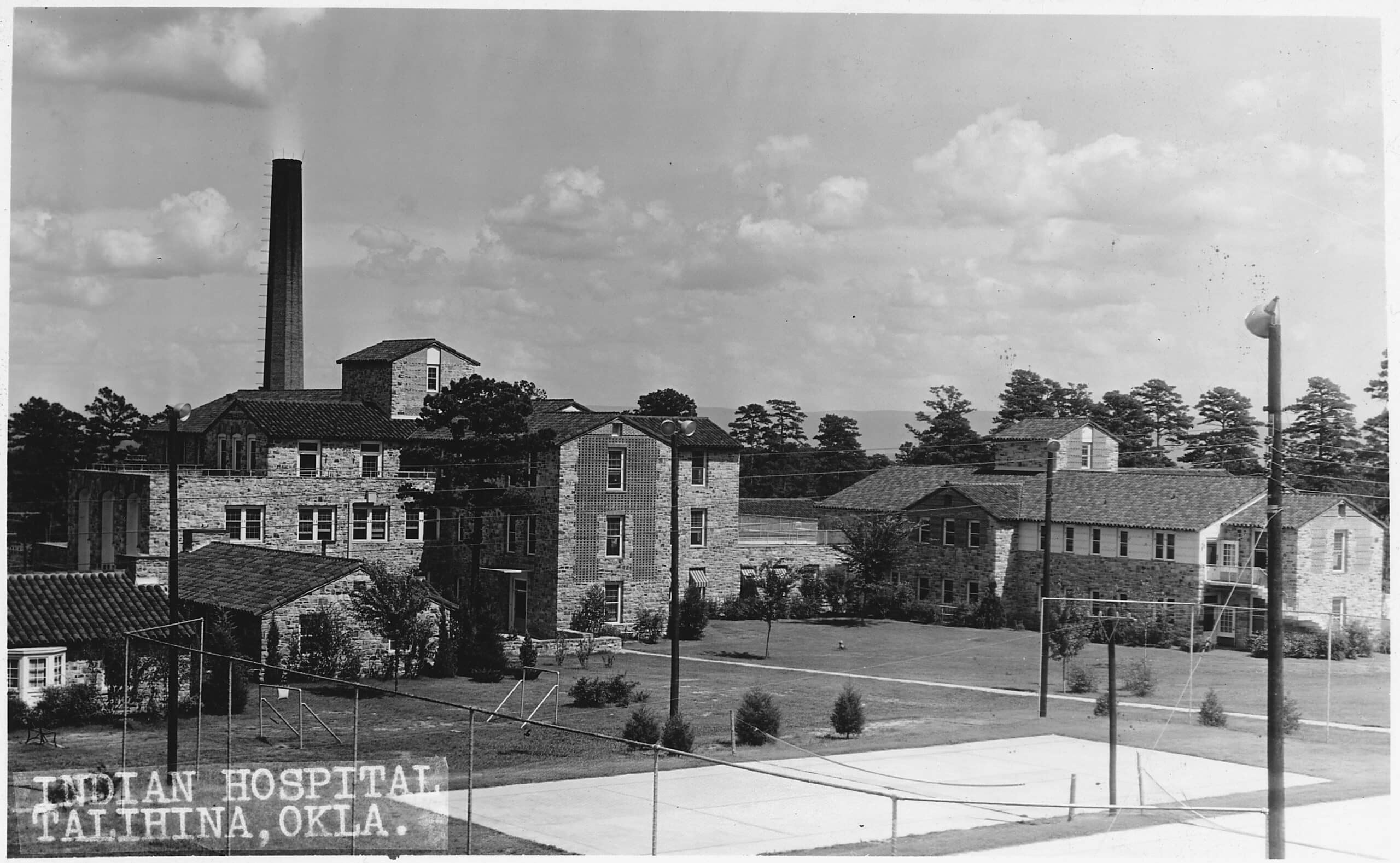
More changes to the hospital came in the 1960s with the closure of the Shawnee Indian Tuberculosis Hospital in 1961. All Native tuberculosis patients, existing and future, would be sent to the Talihina Medical Center. Even then, the tuberculosis ward of the Talihina Medical Center was operating at less than half capacity. Tuberculosis was at a stage where vaccinations were increasing at a steady pace and widespread use of medications meant less time down. By 1963, all tuberculosis patients were cared for in the Eastern Tuberculosis Sanitorium.
The decline continued with the establishment of new health clinics that decreased the distance that Chickasaw patients had to travel, giving preference to those facilities over this one. The jealousy and greed of the United States government continued to show going into the ’70s as people like Senator Henry Bellmon said things like “The Choctaws should open the Talihina Indian Hospital to non-Indians.” Citizens were worried that President Reagan would close the hospital down, claiming it was a waste of taxpayers’ money.
Choctaw Nation Indian Hospital
Under the Indian Self-Determination Act of 1975, tribes were given the option to manage their own healthcare programs. It was around this time that the Choctaw Nation took over and began making its own judgments about how to run the hospital fairly and efficiently. The name was changed to the Choctaw Nation Indian Hospital, although many still referred to it as the Talihina Indian Hospital as it had been referred to for basically its whole life.
The Indian Health Care Improvements Act stated that the federal goal of Indian healthcare is to raise the health conditions among Indians to the same level as that of the general public. This opened them up to additional and deserved funding for things like pharmaceuticals, including insulin, anti-rejection drugs, arthritic drugs and more that they had not been able to provide.
This also left room for the Chief of the Choctaw Nation and their legal entities to argue about the condition of the aging hospital complex and that with these facilities, adequate care could not be maintained. In order to provide quality care, a new complex would need to be built. In 1999, the Choctaw Nation became the first tribe to build its own hospital with the construction of a new $26 million hospital in Talihina.
Since the opening of the new hospital, this facility has sat vacant, although there are a few buildings on the property that are still in use. n 2023, the Choctaw Nation was awarded an EPA Multipurpose Grant to address environmental hazards stemming from pre-1978 building materials in preparation for this important cultural site’s potential reuse or preservation. The recent closure announcement of the former Eastern Tuberculosis Sanitorium Campus, presently known as the Eastern Oklahoma Veterans Center, just up a few miles away, leaves a question on whether these two campuses will be torn down for new development or restored into something amazing for the community.
The Former Choctaw Nation Hospital Grounds are monitored 24/7 by cameras and patrol. All those attempting to visit the property will be charged with trespassing.
Gallery Below of Old Choctaw Nation Indian Hospital
“Apr 14, 1940, Page 73 – The Daily Oklahoman at Newspapers.com – Newspapers.com.” The Past: Read All About It, www.newspapers.com/image/444435488/?match=1&terms=%22choctaw%20hospital%22.
“Aug 01, 1937, Page 9 – Muskogee Daily Phoenix and Times-Democrat at Newspapers.com – Newspapers.com.” The Past: Read All About It, www.newspapers.com/image/898519575/?match=1&clipping_id=181959706.
“Aug 15, 1957, Page 1 – The M’Alester News-Capital at Newspapers.com – Newspapers.com.” The Past: Read All About It, www.newspapers.com/image/593547349/?match=1&terms=%22talihina%20indian%20hospital%22.
“Aug 29, 1957, Page 1 – Muskogee Times-Democrat at Newspapers.com – Newspapers.com.” The Past: Read All About It, www.newspapers.com/image/590661462/?match=1&terms=%22talihina%20indian%20hospital%22.
“Feb 13, 1947, Page 6 – The LeFlore County Sun at Newspapers.com – Newspapers.com.” The Past: Read All About It, www.newspapers.com/image/747448960/?match=1&terms=%22talihina%20indian%20hospital%22.
“Feb 28, 1990, Page 18 – The Atoka County Times at Newspapers.com – Newspapers.com.” The Past: Read All About It, www.newspapers.com/image/1239971000/?match=1&terms=%22choctaw%20nation%20indian%20hospital%22.
“Jun 09, 1939, Page 12 – Muskogee Times-Democrat at Newspapers.com – Newspapers.com.” The Past: Read All About It, www.newspapers.com/image/903087985/?match=1&terms=%22choctaw%20hospital%22.
“Jun 11, 1981, Page 7 – Stigler News-Sentinel at Newspapers.com – Newspapers.com.” The Past: Read All About It, www.newspapers.com/image/1239939874/?match=1&terms=%22talihina%20indian%20hospital%22.
“Jun 13, 1940, Page 1 – Heavener Ledger at Newspapers.com – Newspapers.com.” The Past: Read All About It, www.newspapers.com/image/907873378/?match=1&terms=%22choctaw%20hospital%22.
“Just a Moment…” Just a Moment.., www.choctawnation.com/about/eps/brownfields/talihina-indian-hospital-a-landmark-in-tribal-health/.
“Just a Moment…” Just a Moment.., www.choctawnation.com/news/iti-fabvssa/the-talihina-indian-hospital-part-ii/.
“Mar 25, 1948, Page 1 – The Talihina American at Newspapers.com – Newspapers.com.” The Past: Read All About It, www.newspapers.com/image/589486146/?match=1&terms=%22talihina%20indian%20hospital%22.
“May 06, 1954, Page 1 – The Talihina American at Newspapers.com – Newspapers.com.” The Past: Read All About It, www.newspapers.com/image/747625783/?match=1&terms=%22talihina%20medical%20center%22.
“May 28, 1953, Page 2 – The Talihina American at Newspapers.com – Newspapers.com.” The Past: Read All About It, www.newspapers.com/image/747776441/?match=1&terms=%22talihina%20medical%20center%22.
“Nov 01, 1936, Page 70 – The Daily Oklahoman at Newspapers.com – Newspapers.com.” The Past: Read All About It, www.newspapers.com/image/444472567/?match=1&clipping_id=181959660.
“Nov 04, 1937, Page 8 – The Daily Ardmoreite at Newspapers.com – Newspapers.com.” The Past: Read All About It, www.newspapers.com/image/872983478/?match=1&terms=%22choctaw%20hospital%22.
“Nov 09, 1950, Page 1 – The Talihina American at Newspapers.com – Newspapers.com.” The Past: Read All About It, www.newspapers.com/image/747568644/?match=1&terms=%22talihina%20indian%20hospital%22.
“Nov 24, 1949, Page 5 – The Hartshorne Sun at Newspapers.com – Newspapers.com.” The Past: Read All About It, www.newspapers.com/image/909523752/?match=1&terms=%22talihina%20indian%20hospital%22.
“Nov 28, 1961, Page 9 – The Tulsa Tribune at Newspapers.com – Newspapers.com.” The Past: Read All About It, www.newspapers.com/image/900136375/?match=1&terms=%22talihina%20indian%20hospital%22.
“Oct 04, 1938, Page 3 – Muskogee Times-Democrat at Newspapers.com – Newspapers.com.” The Past: Read All About It, www.newspapers.com/image/903089509/?match=1&clipping_id=181968481.
“Oct 05, 1938, Page 1 – The M’Alester News-Capital at Newspapers.com – Newspapers.com.” The Past: Read All About It, www.newspapers.com/image/903170247/?match=1&terms=%22choctaw%20hospital%22.
“Oct 07, 1937, Page 6 – The Broken Bow News at Newspapers.com – Newspapers.com.” The Past: Read All About It, www.newspapers.com/image/907461081/?match=1&terms=%22choctaw%20hospital%22.
“Oct 19, 1950, Page 8 – The Talihina American at Newspapers.com – Newspapers.com.” The Past: Read All About It, www.newspapers.com/image/747568612/?match=1&clipping_id=181974959.
“Sep 01, 1961, Page 12 – The Tulsa Tribune at Newspapers.com – Newspapers.com.” The Past: Read All About It, www.newspapers.com/image/900119750/?match=1&terms=%22talihina%20indian%20hospital%22.
“Sep 24, 1998, Page 14 – Tulsa World at Newspapers.com – Newspapers.com.” The Past: Read All About It, www.newspapers.com/image/894820200/?match=1&terms=%22choctaw%20nation%20indian%20hospital%22.
“Sep 25, 1938, Page 94 – The Daily Oklahoman at Newspapers.com – Newspapers.com.” The Past: Read All About It, www.newspapers.com/image/444469240/?match=1&clipping_id=181968806.
Talihina Indian Hospital, Talihina Indian Hospital
If you wish to support our current and future work, please consider making a donation or purchasing one of our many books. Any and all donations are appreciated.
Donate to our cause Check out our books!
Thank you for the pictures, me my sister and most of my cousins were born in the old Talihina hospital.
To destroy a building like this should never happen. It needs to be remodel and return to it’s previous state so many more generation can use it.
If they demolish those buildings, a ton of saging and Native shaman blessings need to occur weeks before any scheduled demolition.
I was born there on September 9, 1956. My father and all my siblings were also born there. I was told a majority of my relatives were born there as well. Daney family/Choctaw Indians.
SCArrrrrrrrrrrrrr
I had two surgeries, two daughters born in this hospital. I spent one week before my oldest daughter was born, and total of one month with three false labors before my second daughter was born. In the past a pregnant woman could stay there waiting on to deliver because of the distance most had to travel. It is more than a hour away from where I lived, staying there was convenient, and didn’t have to worry about having the baby on side of the road. It was a beautiful place but lonesome. I also had an aunt to stay there… Read more »
[…] a stone’s throw away from the Old Choctaw Nation Indian Hospital is a building that sits alone on a hill as if it still stands proud of its contribution to medical […]
my husband was born at this hospital, lots of memories for him. his grandparents were paitents too.
To many memories of this hospital. I walked the halls of this hospital plenty of times as my mom and family worked there for years. Had my first child at this hospital.
My 2 oldest boys were born here in 1992 and 1994. Also a brother was born here and lost a set of twins here. It’s ashame they couldn’t remodeled and used for a rehab center or something of the sort, even a museum.
I was born in the old talihina hospital in January 31st 1993
Thank you for the pictures. I grew in TX and OK and remember my great grandparents always went here for all their appointments. I accompanied them on many a trip from McAlester down to Talihina. It was always exciting to go and extra special to get a cheeseburger on the way back. 🙂
My Grandmothers brothers and sister all died there of tb how do i get any info on them?
I was born there in 1979 I would like to go there if possible
I was brought to this hospital from Houston by my husband’s family. I was very ill with graves disease and I had no insurance. I have spent a great deal of time under different circumstances. In some of the so called best hospitals in the world. None of them were as clean and ran as efficiently as this hospital. I was treated with respect and kindness. I will never forget the experience. I felt as though I mattered and I certainly received healing.
My mother father grandparents and my brother and I were all born at this hospital.
myself and all my brothers and sisters were born there starting in 1962…We are heirs of Joe and Dessie Wilson of Buffalo Oklahoma behind Watson and Smithville….
Thank you for this report. Your photos do real justice to this hospital. You have a wonderful eye for color and your use of perspective and space made this an interesting and informative tour. The photo of the bedpan sanitizer made me laugh.
Great photos, really enjoyed this post 🙂
This is amazing! Great job Abandoned Oklahoma!
I was born here in 1996. My mom and dad worked there for a long time. Really wish I could just walk through it just to see where everything was.