


| City/Town: • Pawnee |
| Location Class: • School |
| Built: • 1878 1909 | Abandoned: • 1956 |
| Historic Designation: • Native American Heritage Site |
| Status: • Abandoned |
| Photojournalist: • Michael Schwarz • Mary Evans |
History of Native American Boarding Schools
Many are unaware of the true horrors that occurred at the more than 526 Native boarding schools across the United States. Organizations like the National Native American Boarding School Healing Coalition (NABS) and Tribal communities near and far are aiming to shed light on the terrors and the intergenerational trauma that has followed.
Beginning with the Indian Civilization Act Fund of March 3, 1819 and the Peace Policy of 1869 the United States, in concert with and at the urging of several denominations of the Christian Church, adopted an Indian Boarding School Policy expressly intended to implement cultural genocide through the removal and reprogramming of American Indian and Alaska Native children to accomplish the systematic destruction of Native cultures and communities. The stated purpose of this policy was to “Kill the Indian, Save the Man.”
While the Federal Government established these boarding schools, they enlisted religious organizations like the Catholic, Methodist, Quaker, Episcopal and Presbyterian churches to run them. The institutions had Native children voluntarily or forcibly removed from their homes, families, and communities. Many were taken to schools states away without being able to contact their family.
The boarding schools were used to assimilate rather than “educate” hundreds of thousands of Native children. They were punished for speaking their Native language, banned from practicing their tradition or culture, stripped of traditional clothing, hair and personal belongings. They often suffered physical, sexual, cultural and spiritual abuse and neglect. In many cases and in the present defined law, many of the actions taken against these children would constitute torture. By 1926, more than 80% of Indigenous school-age children were attending boarding schools.
A Federal report released in 2024 discovered that at least 973 Indigenous children died in schools operated or supported by the federal government. But in a separate investigation and report released by the Washington Post in December 2024, they revealed at least 3,104 students had died in boarding schools across the U.S. A number three times that reported by the Federal government.
While the history of Native American boarding schools is overwhelmingly marked by trauma and cultural destruction, it’s important to acknowledge that some students did find positive aspects within their experiences. Many were able to learn vocational training in fields like carpentry, farming, and domestic skills. Students formed strong bonds with each other, creating lifelong friendships and their own communities, which is apparent in the annual reunions for many of these schools.
Native communities continue to face challenges stemming from the intergenerational trauma caused by the boarding school and systemic neglect. The lasting scar that the schools have left on individuals, families, communities, and tribal nations shows. The fight to save Tribal identity, language, traditions, and governance structures is an everlasting mission. These schools disrupted healthy development, fractured family systems, and weakened the cultural fabric of Tribal Nations.
Today, Native youth still experience severe disparities in health, education, and mental well-being. Suicide rates are alarmingly high, poverty is widespread, and graduation rates remain the lowest among all demographic groups—especially in Bureau of Indian Education schools. Despite legislative progress toward tribal self-determination, significant opportunity gaps persist. Without major increases in investment and support, these long-standing inequities will continue to threaten the future of Native youth and their communities.
“Sugarcane” is a 2024 documentary film that explores the history and impact of Canadian Indian residential schools, specifically focusing on the Sugarcane Reserve. The film follows a First Nations investigation into the abuse and deaths that occurred at a residential school, igniting a reckoning among survivors and their descendants. It highlights the resilience of Native communities and their struggle to break cycles of intergenerational trauma while bearing witness to painful truths. Watching this film was life-changing; it is one thing to read about these tragedies, another to watch them firsthand.
History of Pawnee Indian Boarding School
The Pawnee Indian School in Pawnee, Oklahoma, was one of many federally funded boarding schools built around the turn of the century for the purpose of assimilating Indian youth into white American culture. Since native children were considered too “slow” for advanced education, the boarding schools were actually institutions of vocational training, run by military style discipline. As far as I can determine, the official name of the school in Pawnee, which taught children up to the Ninth Grade, was the Pawnee Industrial School, but most people referred to it simply as Pawnee School or descriptively as the Pawnee Indian School or the Pawnee Boarding School.
Boys’ Dormitory
Built: Abandoned:
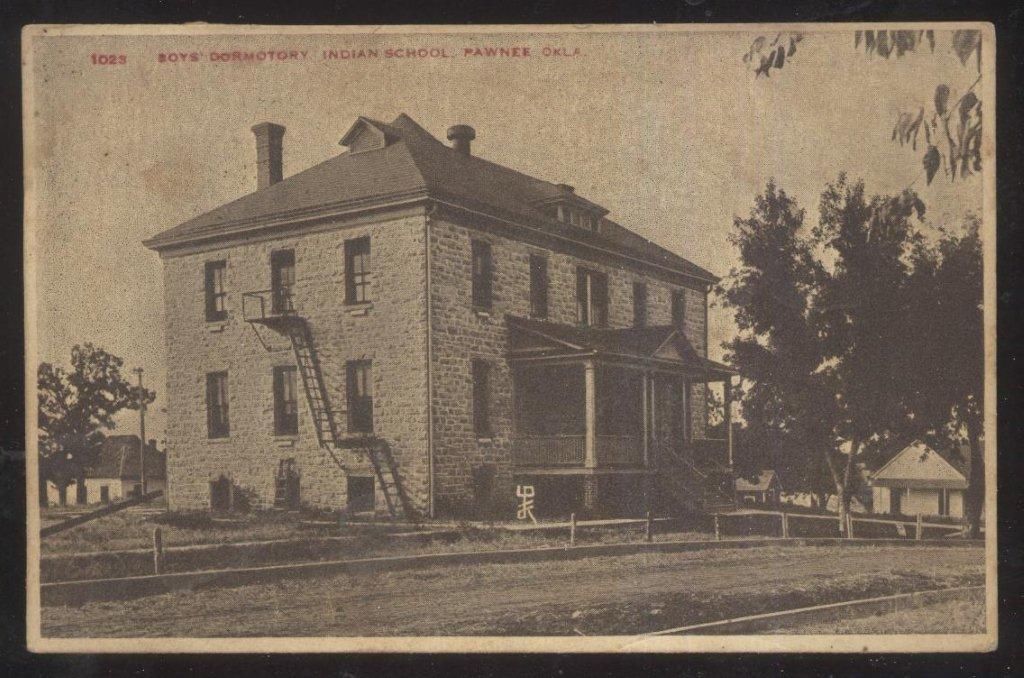
Gallery Below of Pawnee Indian School


https://www.newspapers.com/image/666065865/?terms=pawnee%20indian%20school&match=1
https://www.newspapers.com/image/665826511/?terms=pawnee%20indian%20school&match=1
https://www.newspapers.com/image/631841373/?terms=pawnee%20indian%20school&match=1
https://www.newspapers.com/image/595438258/?terms=pawnee%20indian%20school&match=1
https://www.newspapers.com/image/666062377/?terms=pawnee%20indian%20school&match=1
https://www.newspapers.com/image/666051603/?terms=pawnee%20indian%20school&match=1
https://www.newspapers.com/image/666106689/?terms=pawnee%20indian%20school&match=1
https://www.newspapers.com/image/666049474/?terms=pawnee%20indian%20school&match=1
If you wish to support our current and future work, please consider making a donation or purchasing one of our many books. Any and all donations are appreciated.
Donate to our cause Check out our books!
I spent two years here until it was closed in 1956, thank God I had a roof over my head, electricity and running water. I saw my first TV here. It was a safe heaven for a couple years until closed. I came from a two room house out in the middle of nowhere on Indian land.
Can anyone get in there?
Is it for sale
It is sad that such a big and nice building is abandoned.
These boarding schools ought definitely be made into public memorials. If we don't understand our history, we'll never cope effectively with the present.
April 3 2015, I went to Pawnee for the first time in my life today. I went with a friend to the Pawnee Indian Clinic. May I say, that is a wonderful clinic. She drove me to see the old buildings. Such history. The government needs to restore it back to the original shape and bring people in to see it and teach them the truth about what happened in this school. It is such an historic place.
It should be saved. Not because it was a great place….I wasnt! I should be saved to remember the lives of children lost there.mit should be saved to acknowledge the wrong doing of the U.S. government to the indigenous people. If we let these things fall apart and bull doze them down, we have nothing to remind people of what happened.
Indeed.
This is indeed not a pleasant sight to see a school lying totally in ruins, left without any concern and management. This place holds history and memories for many former students and I think it will be good if the concern authority would try to renovate it.
I'm guessing you've never heard about the treatment of the children in places like this. These "institutions" were built on the principal of "Kill the Indian, Save the man." Upon entry, children recieved hair cuts and had their clothing taken away and give a uniform. They were then told to either pick a name out of a book, or they had a name assigned to them, to rid them of their "savage" identity. If caught speaking in their native tongue, they were beaten, if they tried to run away, they were brought back and they were beaten. Many of these… Read more »
My grandparents attended a boarding school in Kansas. He told me about a time his friend was caught speaking his language. All of the students were lined up along the windows surrounding the courtyard of one the buildings, the instructors told the students "This is what happens you speak in savage tongue." they then proceeded in beating the young boy. My grandpa said that when the insructor got tired, another took his place and continued beating him. My grandpa never saw his friend again after that. I'm sure that there are a few good memories amongst friends that were made… Read more »
Only part of what you is true. i've researched the holocaust for 20 years and Hitler did not learn anything about the treatment of the Jews from the treatment of American Indians.
Rick, what are you trying to say? The meaning and intent of your comment is not at all clear.