


| City/Town: • Pawhuska |
| Location Class: • Hospital |
| Built: • 1927 | Abandoned: • ~1995 |
| Status: • Abandoned • Endangered • Private Property |
| Photojournalist: • Emily Cowan |
As the centennial approaches for the historic Osage County Hospital, I thought what better time to pack up the car and get permission to document this community staple. Two summers ago was the first time I had actually stopped to face the hospital. I began by taking pictures of the outside, making sure to respect the barbed wire fence boundary surrounding it. The ivy was swallowing the west side of the building, and a tree on the east threatened to rip it apart with its roots targeting the foundation.
After trudging through knee-high grass for about thirty minutes, collecting my shots and making a game plan, I set off to get permission. About a year later, I finally got that call. Michael and I arrived on site around 11 am and were given special day access to the three-story structure.
Upon entry, I began seeing the evidence of its most recent purpose, a training facility for the Osage County Sheriff’s Office. Ballistic shields, records, smoke grenades and blank rounds littered the place entirely. But I wanted to find out the before and now that I’ve explored every inch of the building, I can get to the fun part, delving into the history.
Osage County Hospital 1927-1973
While I couldn’t find much documentation of the construction period of the building, it is a three-story, with a basement, brick structure. When it first opened on June 6, 1927 the interior was described as, “Cool gray and white walls, long rows of shining white beds, windows open to the rolling green hills on the east and to landscaped beauty on the west, make the Osage County Hospital undeniably a haven for those who are tired and sick and unable to pay for treatment.”
When I am standing inside this building now, looking to the east, I see houses and a highway, and to the west, the large Osage County Jail. And even so, having grown up driving through the many hills of Osage County, I can still somewhat picture the oasis that this place was.
Mrs. Blanche Miles Hopper, head nurse, made it her mission to restore humanity by providing the fevered and thin with cool beds and warm food to aid in healing. The hospital had 27 private rooms along with two wards. Each of these wards had nine beds to offer to the sick. All twenty-seven private rooms were furnished with a single bed, leather cushioned rocking chair, medium-sized dresser with attached mirror, and a small bedside cabinet. All furniture except for the beds was made of the highest quality, indestructible steel painted to look like walnut wood.
On the front or east side of the building, there is the front door sitting porch, and on the second floor, a balcony that extends the length of the building. Patients were said to enjoy the shade and sun on these areas and “watch the world pass by on the Pershing Highway.”
The laundry, power plant, and furnace were all located in the dreaded basement. Basements are always my least favorite place to go in an unattended building. Between still water, many spiders and often the most deteriorated floor, this one was no different. But I went at least halfway down the staircase anyway. Hanging from a pipe was a large “CAUTION ASBESTOS” sign, another familiar site in many of these basements. To the left the basement opened up into a hog heaven mud pit. Sitting amongst the dirt were the old washing and drying machines, meaning that for the last hundred years, the laundry had stayed in this location. Each of the three floors above the basement contains a laundry chute.
The first floor and the other two floors all contained two bathrooms, one in each wing. The first floor contained an office, the kitchen, patients’ and nurses’ dining rooms, and private men’s rooms. The patients’ dining room was fitted with three long tables that sat twelve people each. The cooking tables were covered in zinc as a sanitary precaution, making them easier to clean.
One of the rooms on this floor also served as a special smoking room, not something that I personally have ever heard of in a hospital but intriguing nonetheless! After more research this smoking room was the only room in the entire building NOT furnished by Osage County, instead the Pawhuska Lions Club furnished it.
The second floor was for women and surgical patients. The elevator shaft begins in the kitchen region. This allowed nurses to bring food straight to the patients on the second and third floors. A special food cart with thermos equipment was used to pass the food out. At the head of the stairs on the second floor was the nurses’ desk.
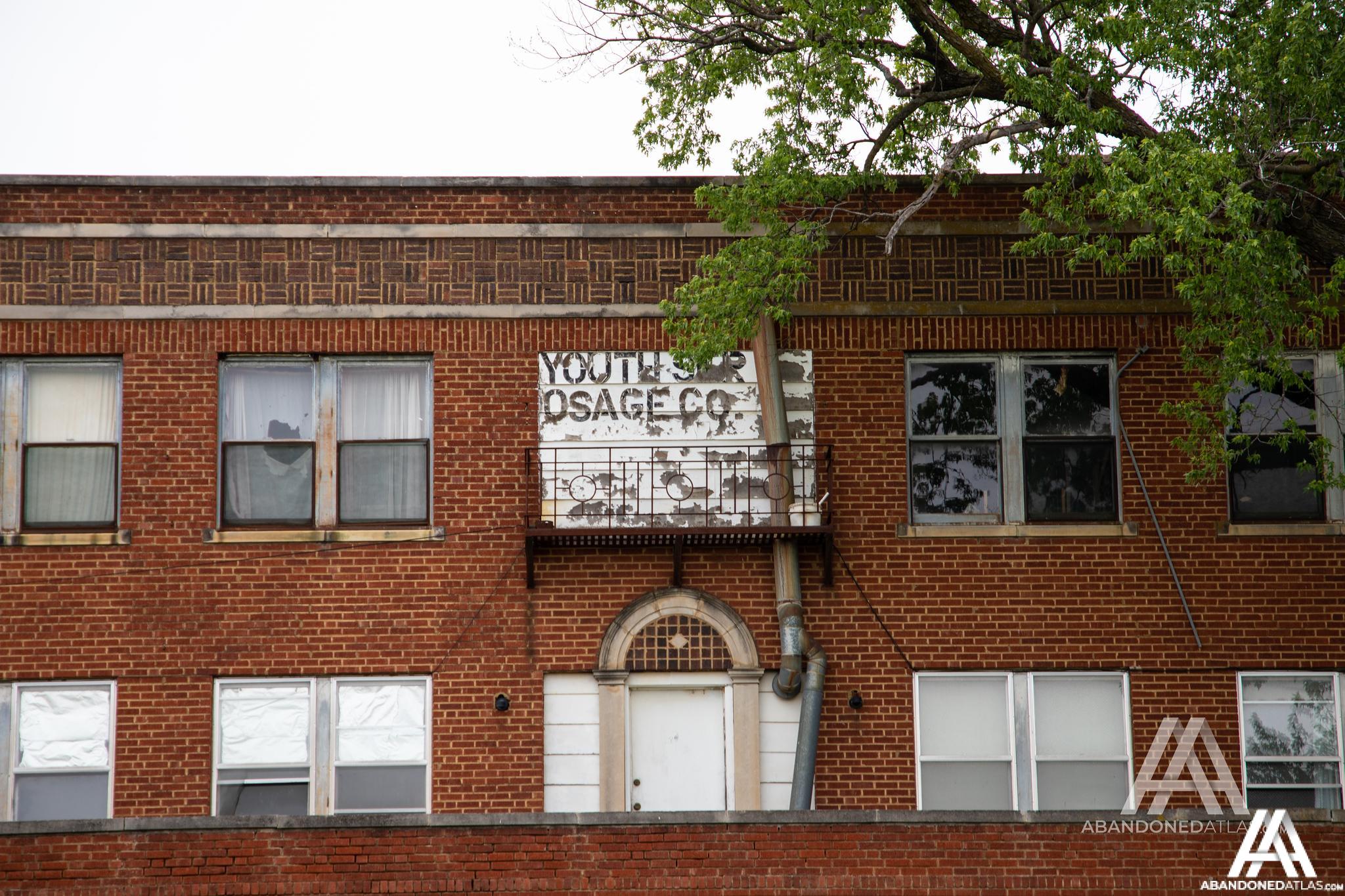
The third floor consisted of the two wards, with the south end for men and women on the north. Adjoining the men’s ward is the doctors’ dressing room. In line with the doctors’ dressing room are the Eye, Ear, Nose, and Throat operating room, the Major Operating room and the sterilizing room. You wouldn’t know it now, but behind the sign on the top of the building would have been a large window in the operating room. This is not only evident from the inside, but was a very common practice as it allowed natural light to fill the room as doctors performed surgeries.
Also located on this floor was the X-ray room and a nursery for babies. The old X-ray equipment still takes refuge on the floor its been on for almost a hundred years. The machine is large and still has papers detailing its origin, “The Merkel X-ray Company”. Also in the same room was a “Bloxsom Air-Lock,” which was a cylindrical steel chamber used in the 1940s to resuscitate newborns experiencing asphyxia (oxygen deprivation) in the delivery room. It infused warmed, humidified 60% oxygen and cycled positive pressure to simulate the intrauterine environment and aid in infant breathing.
Very early after opening the hospital had already seen 24 cases come through its doors. Dr. C.H. Day performed the very first operation. Dr. G. W. Goss was the country physician and in charge at the time of opening. Every doctor in Osage County who is a member of the Osage Medical Society was on the hospital staff. Amongst the staff, apart from those I have already listed, included Dr. R.J. Barritt, Mr. Will Rogers and his wife, Louis De Noya, Mary Hagan, Kate Williams and Mrs. Crowe.
Joe Duncan was the intake coordinator; he was in charge of assessing the patients before admission to make sure they were eligible for the free treatment in the Osage County Hospital. Not only did the hospital provide free stays and operations, but they also provided patients with fresh clothes and even tobacco. Three other homes on the property were to be converted at a later date into the nurses’ home, a laboratory, and a ward for Black patients.
Trouble began cooking up with the other city hospitals, not even six months after its opening. Fourteen doctors from the Osage Medical Association met with county commissioners to criticise the operation of the Osage County Hospital. Doctors detailed that the present plan was crippling local hospitals that had been handicapped by the pay structure of the county hospital which permits payment of a nominal fee for patients was discussed.
In order to resolve this the proposal was that the OCH be made a strictly charitable organization and payments not be permitted for hospitalization. The following resolution was passed: “Be it resolved that the Osage County Medical Society expresses confidence in the commissioners of Osage County and herby respectfully requests them not to accept any patient at the Osage County Hospital until first investigated and authorized in writing representing that such a patient is a pauper and as such is entitled to care at the Osage County Hospital. Further that only patients who are chronically ill be sent to the country hospital and that emergency illness be placed in the three respective city hospitals of Osage County. “
The doctors believed that the three city hospitals in OC were not doing as well due to the fact that many cases that they did not think should be sent to the county hospital went anyway, due to the optional payment structure.
The annual report for the year Nov. 1, 1928, to Nov. 1, 1929 detailed 176 “inmates” treated, 607 patients treated, 17 deaths, 33 births, 120 operations performed, 4 typhoid fever cases, 12 tuberculosis cases, 44 sexually transmitted diseases treated, for a total of 783 patients treated.
Going into the 1940s, the Osage County Hospital was still one of a kind in the State of Oklahoma and had earned an enviable reputation. At the time, the county commissioners ran the hospital on about $18,000 in its charity fund. Operating the farm on the grounds had greatly reduced costs by providing much of the food for the hospital directly.
The success and growth were evident, and the community continued to pour in their support. Believed to be the first in the county, this hospital established a plasma bank in 1941 with the support of the Pawhuska Business and Professional Women’s Club. Another advancement was the purchase of the “Bloxsom Air-Lock” that I had mentioned earlier in 1943, and the polio incubator for children was purchased the following year.
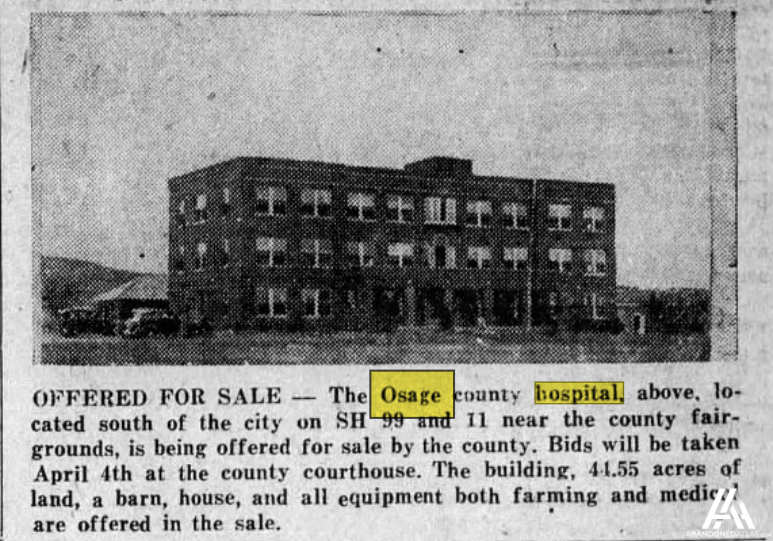 But with most small hospitals like this, especially in growing towns with expanding city hospitals, the momentum faded. Operating at only 14 percent capacity and raising costs led the county to come to a crossroads. They pursued the option of selling the hospital to see if a private company was interested in taking over.
After little to no interest, the Osage County Board of Commissioners passed a resolution to close the hospital on October 1st, 1955. Again, the hospital and its 44 acres were offered up for sale.
But this closure was a trial run of sorts to see how the community would be affected and how the other area hospitals could handle the influx. This thankfully didnt last and the hospital was reopened.
Osage County Youth Shelter 1974-1995
Almost immediately after closing as a hospital, it was transformed into the Osage County Youth Shelter. Although the years after entering the building were a fight to fund the renovation. Measures were tabled, and funding was scarce until 1977. Finally, a favorable comment was given for the $64,800 needed to renovate the aging structure. This renovation would allow the shelter to be in compliance with the state standards and open them up to receive additional funding assistance.
Walking through the second floor was the best indicator of the shelter’s presence here at one point. One corner contained a food donation stash, and in another, a large clothing donation pile of old denim. There was even evidence of cats being cared for on this floor at some point, litter boxes, litter containers, food bowls and a feeding schedule remained.
Osage County Sheriff’s Office Training Facility 2000s-Present
The Youth Shelter seemed to fizzle out around 1995, and after that became the training grounds for the Osage County Sheriff’s Office shortly after the establishment of the jail in 1997. They currently still use it for training, which is evident from the offender posters, blank rounds bullet holes, and smoke grenades scattered throughout the second floor.
After talking with current Sheriff Bart Perrier, he remembers fond memories of the hospital, but says it’s time for it to come down. Concerns have been raised over the safety of even having officers training there. The increased break-ins from civilians have also put officers in the area on high alert, given the proximity to the county jail.
Gallery Below of Osage County Hospital


https://www.newspapers.com/image/906576152/?match=1&terms=Osage%20County%20Hospital
https://www.newspapers.com/image/906576204/?terms=Osage%20County%20Hospital
https://www.newspapers.com/image/659182729/?match=1&terms=%22Osage%20County%20Hospital%22
https://www.newspapers.com/image/659239811/?match=1&terms=Osage%20County%20Hospital
https://www.newspapers.com/image/906559931/?terms=Osage%20County%20Hospital
https://www.newspapers.com/image/906560040/?match=1&terms=Osage%20County%20Hospital
https://www.newspapers.com/image/906742313/?match=1&terms=%22Osage%20County%20Hospital%22
https://www.newspapers.com/image/906576434/?match=1&terms=%22Osage%20County%20Hospital%22
https://www.newspapers.com/image/906558891/?match=1&terms=%22Osage%20County%20Hospital%22
https://www.newspapers.com/image/902630180/?match=1&terms=%22Osage%20County%20Hospital%22
https://www.newspapers.com/image/907892204/?match=1&terms=%22Osage%20County%20Hospital%22
https://www.newspapers.com/image/907688655/?match=1&terms=%22Osage%20County%20Hospital%22
https://www.newspapers.com/image/906385493/?match=1&terms=%22osage%20hospital%22
https://www.newspapers.com/image/906388342/?match=1&terms=%22co.%20hospital%20to%20close%22
https://www.newspapers.com/image/449553039/?match=1&terms=%22osage%20hospital%22
https://www.newspapers.com/image/906388348/?terms=%22co.%20hospital%20to%20close%22
https://www.newspapers.com/image/906810762/?match=1&clipping_id=182274105
https://www.newspapers.com/image/889203760/?terms=%22Osage%20County%20youth%20shelter%22
https://www.newspapers.com/image/890221688/?match=1&terms=%22Osage%20County%20youth%20shelter%22
https://www.newspapers.com/image/892308730/?match=1&terms=%22youth%20services%20osage%20%22
If you wish to support our current and future work, please consider making a donation or purchasing one of our many books. Any and all donations are appreciated.
Donate to our cause Check out our books!
Great job with the photography!