Due to the growing number of incidents at Red Ridge Mansions and the surrounding properties, as preservationists who want to make sure that this site is protected, want to make this absolutely clear:
***Do not attempt to visit, explore, or trespass at Red Ridge.***
This is private property. The site is actively monitored with surveillance cameras along the roads and throughout the grounds, and individuals entering the property are regularly identified, stopped, ticketed, and in many cases arrested.
Just within the past few days alone:
Multiple trespassing incidents were reported in a single day
Underage individuals broke into one of the homes, causing damage and injury that required emergency response
Adults were apprehended inside the building by law enforcement and detained
Entry points were forced open, including boarded windows and secured areas
These are not isolated situations. Over the past three years, people have been caught and confronted on a regular basis.
Much of the recent increase in activity appears to be driven by posts circulating on TikTok and other social media platforms, where locations are shared and treated like trends. Unfortunately, that exposure has led more people to believe the site is safe or accessible. It is not.
Law enforcement is frequently called to the property. Emergency services have already had to respond to injuries sustained during break-ins. Cameras track movement along the roads and entry points, and even when individuals believe they are not being recorded, they often are.
This is not an abandoned place open for exploration. It is an active private property with ongoing monitoring and enforcement.
The risk, legal, physical, and personal; is simply not worth it.
Please respect the property, the owners, and the surrounding community by staying away from Red Ridge and any nearby structures.
These are the five Red Ridge Mansions that sit in the middle of Oklahoma City, three abandoned and soon to be restored and two lived in. Grandson of R.J. Edwards, George spoke with us during a tour of the property and gave us the history behind each of the names. “Granny helped found St. Pauls and Uncle Archie was always in the front row, right side, in the middle of the pew every Sunday for the 11 am service so assuming that’s why its called Preachers Wall.” He continued on saying, “Beneath Green Bows, was named after all the cedar trees surrounding it and was owned by Mary Elizabeth Edwards Thach and is now in private hands and lived in by the Watts Family, Red Ridge (RJ Edwards Mansion) was named around all the red rocks found on this ridge, Windy Hill (John Edwards Mansion) because these trees weren’t here and it was very windy. The final home, known as Creekwood Mansion for its close proximity to Deep Fork Creek and being surrounded by woods is still lived in by George and his family.”
Four out of six of Robert J. and Sadie Edwards’s children when they were grown from schooling and starting their family got a mansion and 15 acres. Talk about creating generational wealth!
The Preachers Wall Mansion is the first of three abandoned mansions, five total on the Red Ridge Mansions property. This was the home of Archibald C. and Sarah S. Edwards, Archibald was the son of RJ Edwards.
This was the first home built on the property in 1932. Sarah had given her new husband Archibald some King Alfred Daffodils as a Christmas gift for their first year of marriage. They were planted in 1931 along the drive leading to the spot where the newlyweds planned to build the home that would become Preachers Wall in 1932. Allegedly, architect Perry Maxwell, who was well-known in the area for designing two golf course clubhouses, was the one to build the house using Archibald’s design. His inspiration for the stone design came from the small, red stone houses near where Frontier City was later built. He and his wife Sarah often rode horses in that area during their courtship.
The rock for the house was quarried from the still extant pit at the foot of the front lawn. The pit was ringed with informally stacked red rocks and at one end a fish pond about ten feet in length was constructed. It had a cement bottom and still more of the red rocks formed a border. A stand of bamboo grew at one edge.
Mary D. Edwards, Daughter of Arch and Sarah recalled a memory when part of Preachers Wall Mansion was being built, “My mother told me once that when the western wing was being added to Preachers Wall, she looked at the scaffolding one day and saw my elder brother Hilary, then about three, gamboling upon it, two stories above the ground. She was frantic with fear at the sight of him. But he survived and is living in Paris today!”
Archibald Edwards was a man of many talents, he was the organizer of family vacations, making sure to take notes about every potential vacation destination. He also kept individual file folders on each state with plenty of fascinating pamphlets and maps. For years, he authored a publication called The Pagan Century, sent regularly to several hundred friends and acquaintances, which addressed subjects such as theater, classical music concerts, and ballet in the Southwestern area. He worked with several architects designing small buildings. He also had the hobby of creating masks.
But arguably one of Uncle Archie’s favorite things as George referred to him, was caring for the daffodils. Reminder his wife gave these to him as a Christmas present during their first year of marriage. But daffodils easily duplicate every few years so the property around Preachers Wall mansion was filled with them.
Gypsy Hogan, a former writer for The Daily Oklahoman, commented some of her memories on this post. “I was friends with Archibald through St. Paul’s. I wrote the article about him and his daffodils that first appeared in The Oklahoman, but he later told me appeared in Europe where it was seen by family, so he joked that I made him famous.” This intrigued me greatly so I hunted down the article to share with you all here.
Farmer’s’ Hobby Springs Into Acres Of Daffodils By Gypsy Hogan April 2, 1995 – More of a country squire than an Oklahoma farmer, But a farmer of sorts nonetheless, he is with springtime being harvest time for this long-time daffodil aficionado. “I’m a very lazy person,” he likes to tell people in his grand storyteller mode. “I like to fish, but only for trout, and only in a clear stream with a dry fly,” says the man who observes such proprieties as always wearing a jacket and tie. “I like to shoot, but only doves because you don’t have to get up early, sit in the cold or have a dog.”
And he likes to raise daffodils, thousands of daffodils, acres of daffodils. Daffodils that remind him of spring time past and promise more to come. Of friends and family, some of whom are still alive. Through the years, Archibald Edwards has become known for his love of fine wines and foreign films; for his life-long devotion to his church, St. Paul’s Cathedral; for his work in the family business, R.J. Edwards Inc.; and for numerous other endeavors.
But his big splash comes each spring. The first daffodils on his estate, the Preachers Wall Mansion, were the King Alfred variety planted in 1931. Since then other varieties have been added by Edwards’ mother, brought from Louisiana at the turn of the century as a new bride moving to Oklahoma. Those sentimental bulbs were later moved to the family home on NW 10, then to the Red Ridge Mansion that his parents built on acreage adjoining Preachers Wall today.
The family as a whole planted and spread daffodils and other flowers throughout the original 265-acre area. Each spring, Edwards carefully watches for the thicker clumps of flowers, then waits for the proper time to roll up his sleeves in a labor of love. “Every five years, you have to separate, ” he said, noting that about 40 bulbs will be in each hefty clump. Through division, redistribution and the passing of time, the bulbs have moved in splendor across the Edwardses’ fields.
With their proliferation, Edwards has come to give thousands of the bulbs to friends and charities, including Oklahoma City Beautiful. About 10,000 bulbs were redistributed last year, each recipient being carefully instructed in the Edwardses’ triangular replanting method. That’s where one slips a spade into the ground, drops in a bulb, turns to the right for another planting, then to the left, then moves over and around for a repeat of the three-step process.
“Never plant in rows,” he cautions, warning about the harshness of such an unnatural look. “Plant in clumps, under trees, where they have nice composition. Or plant in curving swaths through a field, but keep the effect flowing.” And, when you pick daffodils, he advises moderation. A handful of the beautiful flowers is “just a blob of color,” he says in the way one might characterize something as being vulgar and overdone. Pick just two or three for a well-arranged study, the ardent beholder advises. A single daffodil, after all, is a thing of great beauty, a lasting memory.
Mary D. Edwards continues to recount her fond childhood at the home. “We used to “fish” for crawdads when we were young, using kite string with a wad of raw bacon tied at one end. We dropped the bait into the water in front of nooks in the rock border where the big, sluggish crawdads rested. They would grab the bait and we would haul them up and try to plop them into a jar if they did fall back into the drink, which they invariably did.” She continued sharing, “My two most precious memories of growing up there were riding horseback with my Father every Sunday before Church, and driving home from Wilson grade school with my Mother up that serpentine drive.”
The land had many nooks and crannies to gaze upon and get lost in. Mary went on to talk about one of her favorite spots on the property that she often visited when coming home for Christmas. “There was a rock ledge that projected out over Deep Fork Creek, we called it Dripping Rock. For many years there sat atop it, the exposed root system of a long dead tree. We called it the octopus tree, because there was just enough of the trunk left to give the impression of an octopus head and the roots of course resembled the tentacles. The gray color of the barkless surface added even further to the effect….One day my father wrote to me in New York to inform me that Deep Fork had flooded, dislodging our wooden octopus, and carried it off. I am sure I felt as sad as he did when Dripping Rock was ruined for him.”
Life started to slow down for the couple in the 1990s with Archibald being diagnosed with congestive heart failure. It would eventually take his life peacefully at their home on March 21, 1998. Sarah would pass in the home as well on February 9, 2002. With all their children spread out across the world, the home became abandoned.
Red Ridge Mansion
Built: 1934 Abandoned: 1990
The RJ Edwards Mansion was built in 1934 as one of the most amazing examples of Spanish-Italian architecture in Oklahoma City. The home was designed by Norman architect Harold Gimeno and constructed by Raybourn H. Smiser. The foundation was built upon a red sandstone ridge which is where it got the name of Red Ridge Mansion. The mansion is around 6,400 square feet equipt with 26 rooms and 4 1/2 baths, 11 rooms upstairs, 15 rooms downstairs, a basement, a well house, and an incinerator. Arguably, the best room in the house is that of one of the third-floor bedrooms that offer a 360-degree view of the Oklahoma City skyline. Other intriguing features of the mansion include the marble floor living room fit with a large fireplace, a library with clay tile flooring, a formal breakfast room, and a porch with a portico.
Robert J. Edwards, at the time, was one of the wealthiest men in Oklahoma City. He was the founder of R.J. Edwards Inc., allegedly the first municipal bond firm west of the Mississippi, in 1892. As a result of his wealth, he was able to build a substantial house and acquire the many acres with it. The Red Ridge Mansion cost $50,000 which is equivalent to $1,049,059.70 in 2022. In addition to building his own home, he offered five of his children 15 acres and would build them a house as well upon their marriage.
Robert passed away in 1946, leaving his widow in the Red Ridge Mansion to occupy the huge house alone. The children had grown and even though three lived nearby, having a huge house like that to yourself would be pretty lonely. His widow, Sadie Cason Handy Edwards, passed away in 1966, leaving the residence unoccupied for a few months.
Oklahoma Museum of Conservative Art at Red Ridge
In 1967, the Oklahoma Museum of Conservative Art made their home in the Red Ridge Mansion, leasing the property from the Edwards Family. It was the only private museum to serve Oklahoma City, specializing in traditional artists. The OMCA at Red Ridge provided the community with sponsored classes in addition to exhibits. They didn’t stop there either offering traveling exhibits, a lending library and high school drawing competitions. The art museum was free to the public with the exception of special exhibits. They resided in the mansion until July 1975, when the museum had a new interest in getting a bigger and newer building.
The home remained in the heirs’ hands, who attempted to revive the property. The home had been overridden with ivy which after being remove,d had left the walls pockmarked. Also causing issues was moisture; the home had many brass features as well as an iron railing on the staircase. Grandson of R.J., George Edwards, was especially excited about the work to the house noting that exterior walls were being prepped for painting and plans for upgrading the mansion. It had in recent years been offices for an advertising firm, a magazine publisher and a postal mailing company. George Edwards was happily ready to see it through that the home be refurbished and the remaining acreage turned into an office park while still keeping the foliage.
He can remember how his grandmother rode to the property in a chauffeured limousine, tossing daffodil bulbs, and having a gardener plant them where they fell. They can still be seen scattered throughout the land today. “My great-grandfather happened to be a gardener/handyman/chauffeur hired by the wife of RJ Edwards, Sadie. He was first hired to watch over the construction supplies while the house was being built in 1935. Once completed, he worked at the mansion for 8 years,” said Heidi Shelley.
00votes
Article Rating
If you wish to support our current and future work, please consider making a donation or purchasing one of our many books. Any and all donations are appreciated.
Emily is a two-time published author of "Abandoned Oklahoma: Vanishing History of the Sooner State" and "Abandoned Topeka: Psychiatric Capital of the World". With over two hundred published articles on our websites. Exploring since 2018 every aspect of this has become a passion for her. From educating, fighting to preserve, writing, and learning about history there is nothing she would rather do.
error: Content is copyright protected by The Abandoned Atlas Foundation. To request the use of information/media: board@abandonedatlas.com or copy and paste link to post
wpDiscuz
0
0
Have history here? Would love hear your stories or your thoughts.x



 These are the five Red Ridge Mansions that sit in the middle of Oklahoma City, three abandoned and soon to be restored and two lived in. Grandson of R.J. Edwards, George spoke with us during a tour of the property and gave us the history behind each of the names. “Granny helped found St. Pauls and Uncle Archie was always in the front row, right side, in the middle of the pew every Sunday for the 11 am service so assuming that’s why its called Preachers Wall.” He continued on saying, “Beneath Green Bows, was named after all the cedar trees surrounding it and was owned by Mary Elizabeth Edwards Thach and is now in private hands and lived in by the Watts Family, Red Ridge (RJ Edwards Mansion) was named around all the red rocks found on this ridge, Windy Hill (John Edwards Mansion) because these trees weren’t here and it was very windy. The final home, known as Creekwood Mansion for its close proximity to Deep Fork Creek and being surrounded by woods is still lived in by George and his family.”



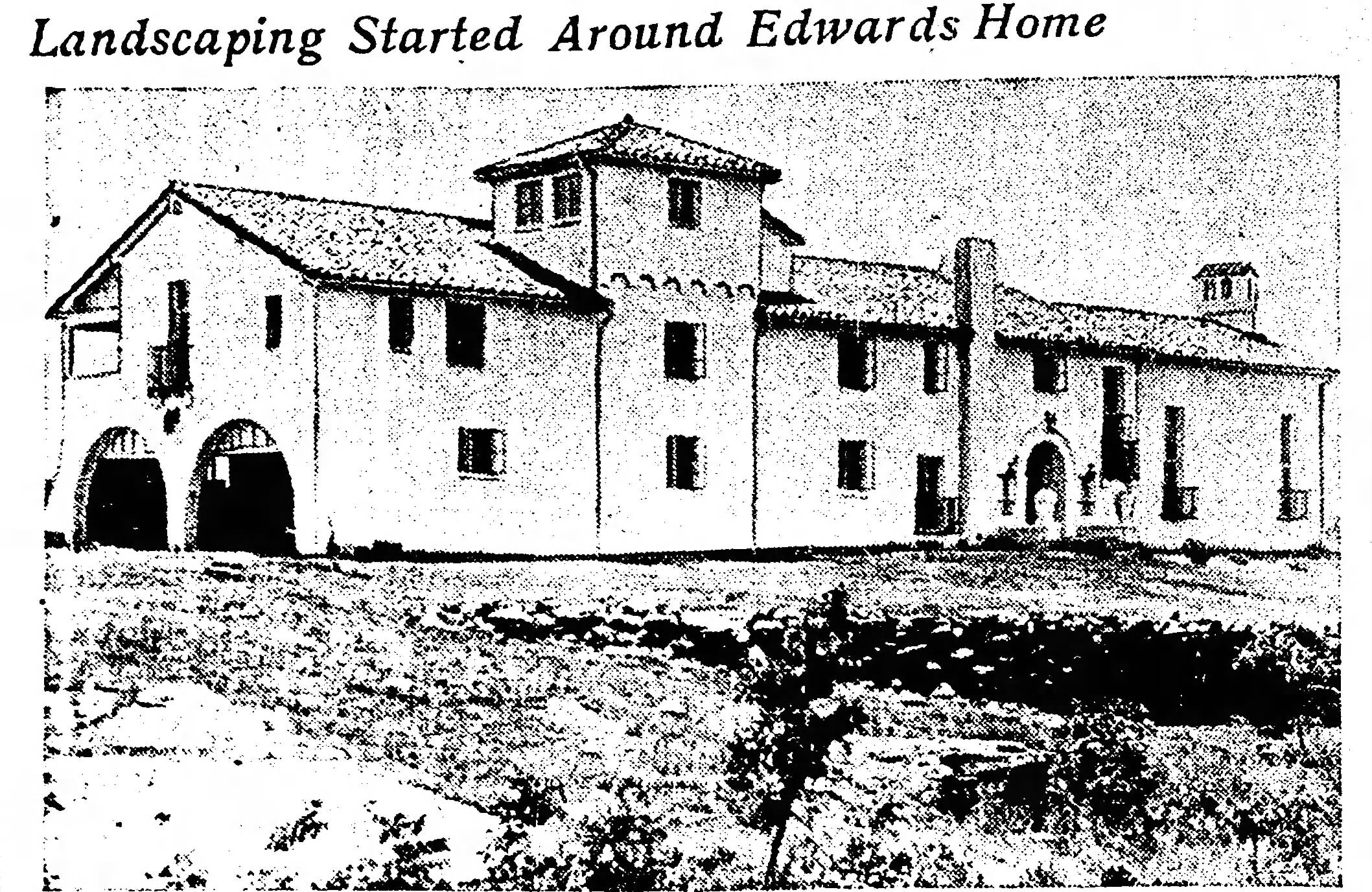 The RJ Edwards Mansion was built in 1934 as one of the most amazing examples of Spanish-Italian architecture in Oklahoma City. The home was designed by Norman architect Harold Gimeno and constructed by Raybourn H. Smiser. The foundation was built upon a red sandstone ridge which is where it got the name of Red Ridge Mansion. The mansion is around 6,400 square feet equipt with 26 rooms and 4 1/2 baths, 11 rooms upstairs, 15 rooms downstairs, a basement, a well house, and an incinerator. Arguably, the best room in the house is that of one of the third-floor bedrooms that offer a 360-degree view of the Oklahoma City skyline. Other intriguing features of the mansion include the marble floor living room fit with a large fireplace, a library with clay tile flooring, a formal breakfast room, and a porch with a portico.